

New global hub advances Arizona’s semiconductor industry
The SPARK Center builds on growing Arizona-Taiwan ties, bringing university research and industry together to accelerate semiconductor commercialization and workforce development.
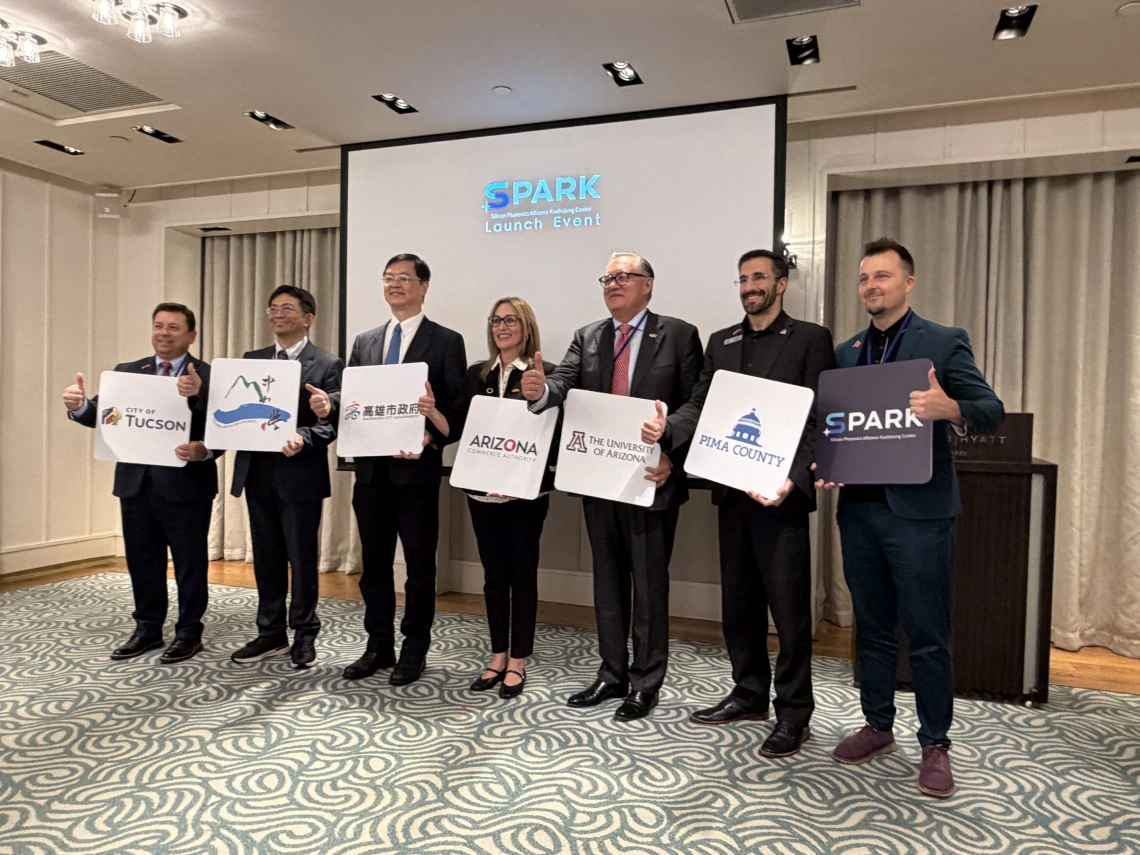
Representatives from the organizations forming the Silicon Photonics at Arizona-Kaohsiung Center announce the partnership's launch at SEMICON Taiwan in Taipei. From left: Mike Czechowski, City of Tucson chief economic development officer; Chih-Peng Li, National Sun Yat-sen University president; Ta-Sheng Lo, Kaohsiung City deputy mayor; Sandra Watson, Arizona Commerce Authority president and CEO; Tomás Díaz de la Rubia, University of Arizona senior vice president for research and partnerships; Dr. Matt Heinz, Pima County Board of Supervisors vice chair; and Heath Vescovi-Chiordi, Pima County director of economic development.
Photo by the Office of Research and Partnerships
The University of Arizona and National Sun Yat-sen University, or NSYSU, today launched a joint research and education center focused on developing new technologies to improve the performance and efficiency of the systems that power artificial intelligence and high-performance computing. The center also will train the next generation of semiconductor and photonics professionals in Southern Arizona and Taiwan.
Semiconductors are the foundation of computer chips, powering technologies that are central to modern life, industry and the global economy. Photonics uses light to transmit and process information, enabling data to move at high speeds while using less energy than traditional electrical connections.
U of A Senior Vice President for Research and Partnerships Tomás Díaz de la Rubia and NSYSU President Chih-Peng Li announced the partnership, the Silicon Photonics at Arizona-Kaohsiung Center, or SPARK, during SEMICON Taiwan, a major industry gathering in Taipei. The city of Kaohsiung is a global industrial and technology hub in Taiwan and home to NSYSU.
“I can think of no more fitting place to launch SPARK than here in Taiwan, at the center of a semiconductor industry that has transformed the global economy,” Díaz de la Rubia said. “We are also at an extraordinary moment for this technology. AI and high-performance computing are pushing the limits of how quickly and efficiently we can move enormous amounts of data. Meeting that challenge will require new approaches that bring semiconductors and photonics together. SPARK puts researchers, students and industry from Arizona and Taiwan at that intersection, with an opportunity to help shape the future of computing.”
SPARK builds upon a landmark six-party collaboration agreement signed in March between the universities and civic leaders from Tucson, Pima County, the Arizona Commerce Authority, or ACA, and the City of Kaohsiung to deepen cross-border economic and technological ties.
“Arizona and Kaohsiung share an important partnership built on shared strengths across high-tech sectors including semiconductors, advanced manufacturing, and research and innovation,” said Sandra Watson, president and CEO of the ACA. “By bringing together university research and industry, SPARK will accelerate semiconductor innovation, expand commercialization pathways, and grow Arizona's strategic collaboration with Kaohsiung. We commend the leadership from the University of Arizona and NSYSU and look forward to building on this milestone.”
By moving data at the speed of light rather than through electricity, this joint initiative is designed to accelerate the commercialization of next-generation computing in Southern Arizona and Kaohsiung in Taiwan.
“By developing a robust talent pipeline, we are providing Southern Arizona companies with the resources they need to grow while also creating opportunities for new suppliers, startups and investments. This initiative offers a chance to strengthen our international efforts and further establish Pima County's position in the global semiconductor economy. The SPARK Center will benefit our entire region and its economy by creating highly paid, high-tech career opportunities,” said Heath Vescovi-Chiordi, director of Pima County Economic Development.
These agreements reflect a growing regional effort to strengthen Southern Arizona’s semiconductor capabilities. Other recent developments include the U of A’s semiconductor fabrication facility expansion, supported by the ACA.
Faster, more efficient computing for industry
To achieve these goals, SPARK will bring researchers and industry partners together to improve how data moves between computing components. Optical systems can transmit data at very high bandwidths with lower energy loss than electrical connections. This includes advanced packaging, which brings chips and other components together more closely to improve data transfer and efficiency. SPARK also will explore co-packaged optics, which places optical components alongside computer chips, shortening electrical connections to reduce power consumption, heat generation and data lag.
These advancements are particularly critical as AI workloads expand, driving up power demands at data centers. According to the Lawrence Berkeley National Laboratory, data centers could account for 11.8% of all U.S. electricity use by 2030. By integrating energy-efficient optical capabilities directly alongside the computer chips that power AI, the partnership aims to develop new approaches for meeting the demands of increasingly powerful computing systems.
Building Southern Arizona’s semiconductor future
The partnership also will create new opportunities for education and workforce development, including hands-on training centers in Arizona and Kaohsiung.
“SPARK strengthens the growing innovation corridor between Southern Arizona and Taiwan by connecting Tucson’s world-class expertise in optics and photonics with Kaohsiung’s leadership in semiconductors and advanced manufacturing,” Tucson Mayor Regina Romero said. “Together, we are preparing the next generation of workers, researchers and professionals in both regions for high-quality careers in the industries shaping the future of the global economy. The technologies developed through this partnership can support energy-efficient computing, strengthen renewable-energy systems and accelerate our progress toward a carbon-neutral economy.”
Dr. Matt Heinz, vice chair of the Pima County Board of Supervisors, echoed local support for strengthening the region’s semiconductor industry.
“Pima County is proud to support the SPARK initiative alongside our partners at the U of A, City of Tucson, NSYSU and the Kaohsiung City government,” Heinz said. “SPARK realizes the potential of collaboration among academia, government and industry, and will bring research, development and prosperity to Pima County. It’s truly an exciting project with unlimited potential.”
SPARK will offer jointly developed courses, online learning opportunities for industry members and academic programs that allow students to earn a degree through a series of smaller credentials.
Industry partners will play a central role in shaping SPARK’s research agenda. Participating companies will identify and select projects aligned with their needs, engage directly with university researchers and gain early access to research results and students with expertise in areas including engineering, optical sciences, information science and physics. The center also will help companies translate research into future products by providing opportunities to build on research findings and intellectual property developed through SPARK.