


Bringing leading scholars and innovators to campus to share transformative knowledge, inspiring insights, and vision that will shape the future.

Darío Gil, Ph.D.
Innovation in an Era of Convergence: The Genesis Mission, Artificial Intelligence and Transformational Discovery
Tuesday, Nov. 3 | 3:30-4:30 p.m. Followed by an in-depth conversation with President Suresh Garimella
Grand Challenges Research Building

Ramayya Krishnan, Ph.D.
AI-driven workflow-to-workflow transformation: Two heads are better than one
Thursday, Nov. 5 | 3-4 p.m. with reception to follow.
Grand Challenges Research Building

Retired Lt. Gen. Andrea D. Tullos
Every Day's a School Day
Thursday, Dec. 3 | 3:30-4:30 p.m. with reception to follow.
Grand Challenges Research Building
Your opportunity to engage with thought leaders and campus colleagues.
Past Lectures from this Series
Brian P. Schmidt, Nobel Laureate and Distinguished Professor of Astronomy at the Australian National University, delivered a lecture on the cosmos, explaining what we know about the universe and the mysteries that remain.

Brian Schmidt toured the anechoic chamber in the University of Arizona’s Applied Research Building during his time on campus.
Photo by Kris Hanning, U of A Office of Research and Partnerships
Why It Matters: Understanding the state of the universe—from the Big Bang to its accelerating expansion—informs fundamental physics, cosmology, and humanity’s place in the cosmos. Schmidt’s research on the accelerating universe reshaped how scientists view dark energy and cosmic evolution, deepening our grasp of the universe’s past and future.
This lecture covered:
- How scientists have pieced together the universe’s history, composition, size, density, shape and age.
- The evidence for cosmic acceleration and the role of dark energy.
- Current inconsistencies in measurements and open questions guiding future research.
Speaker
Brian P. Schmidt is a Nobel Laureate in Physics, recognized for discovering the accelerating expansion of the universe—a breakthrough that revealed dark energy’s profound influence. He earned undergraduate degrees from the University of Arizona and his PhD from Harvard University, and he serves as Distinguished Professor of Astronomy at the Australian National University. His research spans supernova cosmology and the large-scale structure of the universe.
This lecture occurred Oct. 23, 2025, at the Grand Challenges Research Building.
Kyle Harper, Blankenship Chair in the History of Liberty and Professor of Classics and Letters at the University of Oklahoma, placed today’s sixth extinction debate in deep historical perspective, drawing on human history, ecology, and long-term environmental change to illuminate the biodiversity crisis.

Kyle Harper presented his research on the biodiversity crises in the context of history during the Office of Research and Partnerships’ Distinguished Research Lecture Series on Nov. 3.
Photo by Kris Hanning, U of A Office of Research and Partnerships
Why It Matters:
The sixth extinction refers to the ongoing, human-influenced loss of biodiversity—a rate of species decline far above natural background levels that could rival the five major mass extinction events of Earth’s past. Understanding these patterns through history helps connect cultural, political, and ecological forces that shape life on this planet, offering insights into how we might respond.
This lecture covered:
- How humans have shaped Earth’s biodiversity over tens of thousands of years, from Ice Age megafauna extinctions to agricultural and imperial expansions.
- Why interdisciplinary approaches, including history and natural sciences, enrich our understanding of the current biodiversity crisis.
- The links between cultural, political, and ecological processes in framing the sixth extinction and what that means for research and action.
Speaker
Kyle Harper is the Blankenship Chair in the History of Liberty and Professor of Classics and Letters at the University of Oklahoma, noted for his interdisciplinary work on environmental history and human-environment interactions. His research spans major global themes—including climate change, infectious disease, and biodiversity—through the lens of deep history, connecting human cultural developments with long-term ecological change. He earned his doctorate in history from Harvard University and is the author of multiple award-winning books.
This lecture occurred Nov. 3, 2025, at the Grand Challenges Research Building.
Dr. Edward Moses, CEO of Longview Fusion Energy Systems, has led billion-dollar projects like the National Ignition Facility and the Giant Magellan Telescope. A National Academy of Engineering member, he holds 20 patents and has over 150 peer-reviewed papers.
Why It Matters: Fusion energy—powering the Sun—could be the ultimate clean, sustainable energy source. A 2022 breakthrough at the National Ignition Facility proved controlled fusion gain, bringing commercialization within reach.
This lecture covered:
- How laser-driven fusion evolved from the first laser in 1960 to today.
- The role of fusion in energy security, climate solutions, and global leadership.
- What’s next in commercial fusion energy.
Speaker
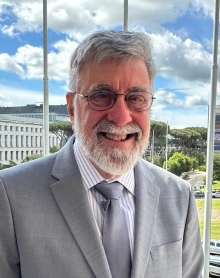
Dr. Edward Moses is CEO of Longview Fusion Energy Systems for commercializing laser fusion energy. He led multibillion dollar projects including the National Ignition Facility at LLNL and the Giant Magellan Telescope Organization. Dr. Moses is a member of the National Academy of Engineering, and a Fellow of the OSA, AASS, and SPIE. Dr. Moses is a recipient of the Edward Teller Medal, the R&D 100 Award for Peregrine cancer radiation therapy, the Project of the Year Award for the NIF, and Jefferson Award for Public Service. He has over 150 peer-reviewed papers and 20 patents.
This event occured on Feb 18, 2025 in the Grand Challenges Research Building, room 130.